Pool Water Testing: Is it Really THAT Important?
Your pool water may look clear, but appearances can be deceiving. Regular water testing is one of the most important steps in maintaining a healthy, safe, and long-lasting swimming pool. Proper water chemistry not only keeps the water confortable for swimmers, but also protects your pool equipment, prevents costly repairs, and helps avoid common issues like algae growth, staining, and scaling. Understanding what to test and why it matters can save both time and money while keeping your pool in top condition year-round.
Q: Is testing your water that important?
A: Yes! It is one of the most importance maintenance tasks for your pool. Testing your pool water gives you the necessary information on what chemical parameters are in or out of range. Maintaining proper chemical balance keeps your pool sanitary and clear, protects the pool’s surface and equipment, and prevents eye or skin irritation.
Q: How often should I test my pool water?
A: You should test your pool water or have it tested by a professional once per week at minimum. Your water may be balanced today, but there are so many factors that can affect your water chemistry. The temperature of the pool water, the number of swimmers (including dogs or other animals), the time that your pool gets direct sunlight, how much rain has fallen, how much debris has gotten into the pool, has the pool been overfilled or is there a leak, etc. are all factors that can quickly change your chemical balance. If you are treating a specific issue like an algae bloom or stain treatment, testing your water chemistry more than once per week may be necessary.
Q: Does it matter how I collect my water sample?
A: Yes (and no). Ideally, you would collect your sample at least 4 inches from the water surface and away from any returns or jets. Frequently in the pool industry, you will hear that you should put your water sample bottle into the water until your elbow reaches the water surface. There is absolutely nothing wrong with this method and will get you the best representative sample. In our experience, it does not make a perceptible difference when testing water poolside with test strips or a liquid reagent kit. You may see slight differences with a photometric test at a shop, but not enough to substantially change the recommended chemical dosages.
Q: I just bought this house with a pool and found some test strips in the garage. Will these work?
A: That depends. All testing methods use reagents, and all reagents have an expiration date. Generally speaking, expired reagents will reveal lower levels of whatever is being tested than what is actually present in the water which could lead to overdosing chemicals. Additionally, test strips should be stored in a cool, dry location.
Q: What is the best way to test my pool water chemistry?
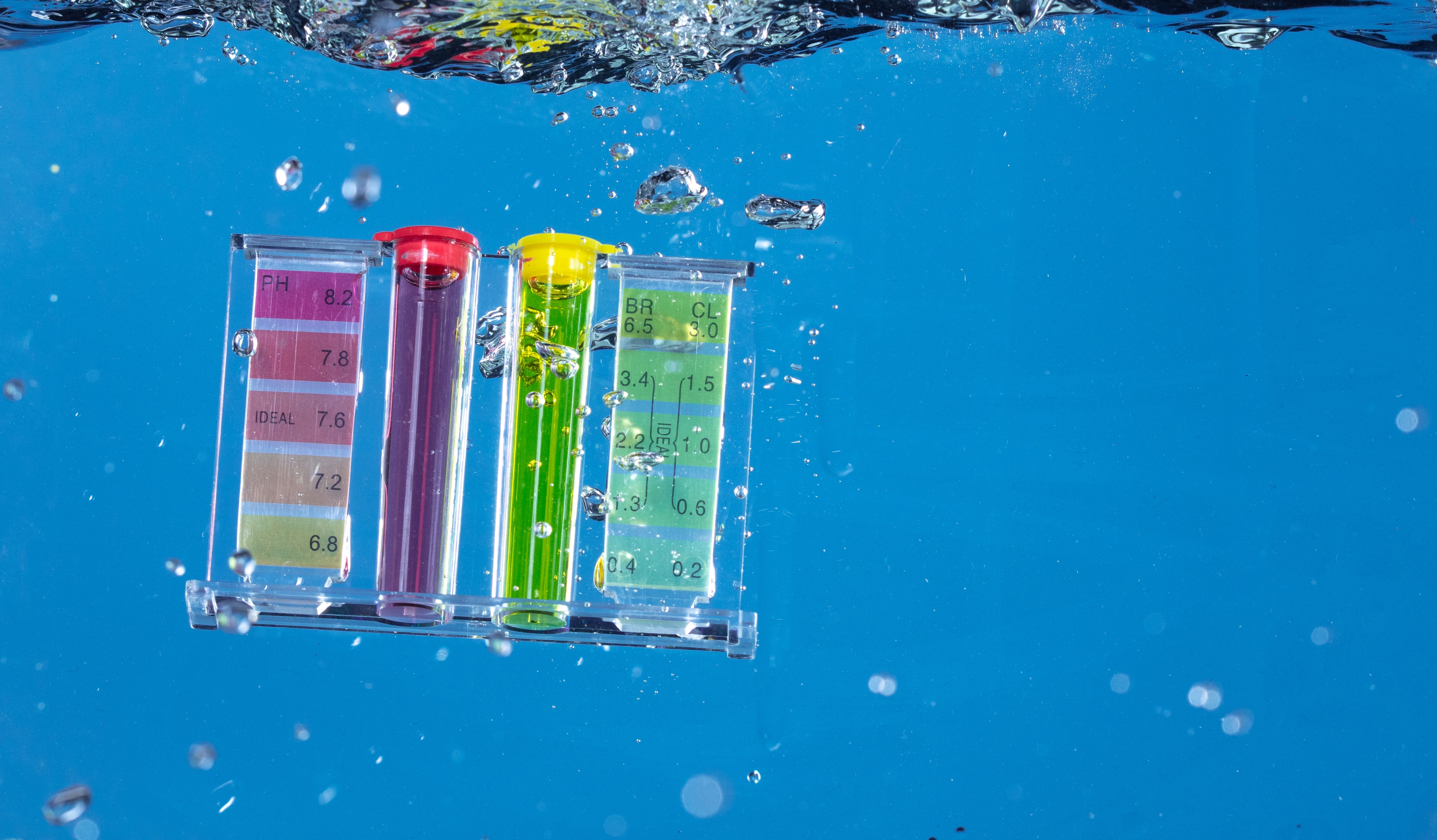
A: The best way to test your water is regularly! The three most common ways to test your water are with test strips, liquid reagents, or photometric. They all have pros and cons.
Test strips are by far the quickest and easiest to use but may not be as accurate as the other ways to test your water. The strips have multiple pads with individual reagents that allow you to check four to seven different parameters with a quick dip into the water. After waiting a short time (usually around 15 seconds), the pads will change colors. The pad color is then matched with a color comparator to determine what range a particular chemical is in. The chemical ranges are generally broader than what is found with a liquid reagent test kit. Test strips are frequently used by homeowners and some service companies for their ease-of-use.
Liquid reagent test kits are quite a bit more accurate, but more time-consuming and costly. Each test must be completed individually using a small amount of liquid reagent mixed with a pool water sample. The reagent bottle must be held completely vertically while it is being added to the water sample as its orifice is specifically engineered for each drop to be the same size. If the bottle is held at an angle, the amount of reagent that is added to the water sample will be too much and the results will not be as accurate. Some of the tests require a certain number of drops to be added and then comparing the color change with a color comparator with a smaller range than that of test strips. Other tests require counting the number of drops and then multiplying that number by a factor which yields very accurate results. Liquid reagent test kits are used by many service companies and some retailers.
Photometric water testers are generally considered to be the most accurate but the costliest per test. These tests remove a variable that affects the accuracy of the previous two test types – the human eye. Even if you are not color blind, individuals do not perceive color exactly the same. Test strips and some of the liquid reagent tests require the use of a color comparator. While the difference in color perception will not typically have a major impact on testing accuracy and therefore chemical dosing, many people like the accuracy of the photometric test. These testers are typically found in retail shops as they are more expensive and more sensitive than the other two types of water testing. They use LEDs to standardize the amount of light that passes through the colored water sample and an optical system that reads the color wavelength. However, photometric testers lose their accuracy advantage if they are not calibrated or cleaned properly. Any dust buildup or residue (streaks) from cleaning the optical system can have an effect on accuracy of the test.
If you're experiencing water chemistry issues, noticing changes in your pool water, or simply want the peace of mind that comes with professional care, we're here to help. Contact us for expert advice, water testing assistance, or to learn more about our weekly pool service programs. Our experienced team can help keep your pool looking its best so you can spend less time worrying about maintenance and more time enjoying your backyard!
Posted in: Health & Wellness , Pool Maintenance , Pool Service , Pool Tips
Tags: pool-maintenance-tip , pool-service , pool-water-chemistry